What this page is: our shelf card for one new book. Read our take below, then tap Buy Now.
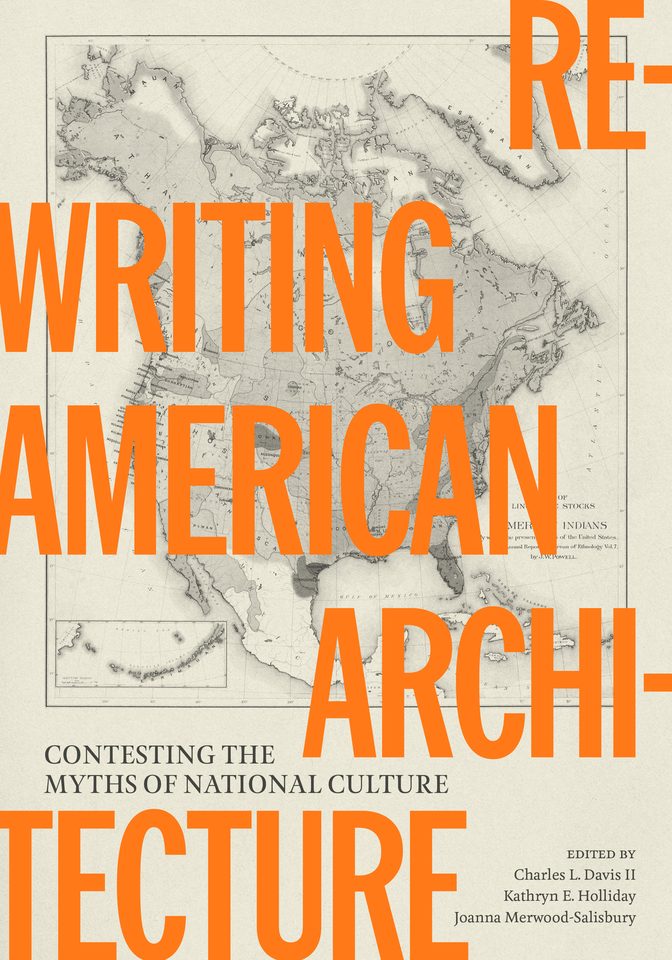
Rewriting American Architecture
The usual story of nineteenth-century American architecture is one of steady progress toward a single national style. The twenty essays in this collection argue that the buildings tell a messier story, shaped by race, labor, settler colonialism and territorial expansion. They range from Black builders and churches to Indigenous spatial practices, the Texas border and the politics of who counts as an architect.
Our read: the thesis lands: "The history of architecture is not only a history of design but also a history of the land and of those who labored to shape it" (p. 6). The best essays are case studies you can stand in, and the back half is the strongest stretch. Tara A. Dudley traces Austin's Black stonemason Mason family, whose freedmen's settlement, Masontown, has "not even a historical marker" today (p. 82). Stephen Fox reads Brownsville and Matamoros as one border place. The mahogany essay follows the wood from coerced logging to English country houses and ends on this: "It is appropriate, then, that mahogany so commonly became doors—architectural devices for discretionary exclusion" (p. 201). The Standing Rock chapter, set around the Northern Pacific's Mandan depot and the 1888 land commission, ends cold: "In the end, only 22 out of 1,133 eligible men cast a vote" (p. 269). The Library of Congress essay on the building's 33 "ethnological heads" quotes the plain plan: "in the rear we have put the black races" (p. 332). Joanna Merwood-Salisbury takes apart the claim that Chicago's Home Insurance Building was the first skyscraper (p. 342), and notes that Jenney himself called it "the successful application of methods in use, with some variation in detail" (p. 347). The closing piece on where Wright's "Usonia" came from is a fun bit of word detective work.
Good to know: the introduction is the hardest going. It leans on terms like "ethnonational mythologies" and "historiographic construction" (pp. 4, 6), so start with the case studies if you like. With twenty contributors it reads more like a set of strong essays than a single argument, and it is not a picture-book survey.
In short: an important corrective that gets better as it goes. Start with the mahogany, Standing Rock, Library of Congress and skyscraper chapters, then double back.
Twenty contributors range across the long nineteenth century, from the early republic to the New Deal, with essays on Austin, Brownsville and Matamoros, Dakota Territory and Southern California. It is 408 pages with 114 black-and-white photographs. The University of Texas Press kindly sent us a review copy, and we read it in full. Our page numbers come from that copy and may differ slightly in the finished book.
What to do: if you love old buildings, historic preservation or American history, and want to see who built them and who was left out of the textbooks, tap Buy Now.
Buy NowTip the Booktender